
CGI Finance
Investing
Learn how investing actually works, put your money to work for the long term, and know exactly where to open an account — before you ever buy a single share.
Start here
The fundamentals, in plain English.
If you only read a handful of things about investing, read these first. Each one answers a single question without the jargon.
Investing
What is compound growth?
The concept behind why starting early matters more than almost anything else.
Read article→Investing
Index funds vs. ETFs
Two wrappers around nearly the same idea — the honest difference, and why the fee matters more.
Read article→Strategy
The order to invest your money
A framework that puts guaranteed and tax-free returns first, so limited dollars go furthest.
Read article→Retirement
Traditional IRA vs. Roth IRA
The two most common retirement accounts work differently when it comes to taxes.
Read article→Retirement
Should I contribute to my 401(k) before investing elsewhere?
How employer matching, taxes, and other priorities usually factor into the order.
Read article→Go deeper
Invest on purpose, not on a tip.
Two guides that separate real investing from the noise — how to size up anything before you buy it, and how to tell investing apart from speculation.
Investing
10 things to understand before you buy any investment
A plain checklist for sizing up any stock or fund — so you're investing on purpose, not on a tip.
Read article→Investing
Investing vs. speculation vs. gambling
Three things that look alike and behave completely differently. Knowing which one you're doing changes everything.
Read article→Run the numbers
See what investing could become.
Free calculators that turn a monthly contribution into a real projection — no signup required.
Compound growth calculator
See what steady investing could grow into over time — and how much of the final number is growth you never had to contribute.
Free Calculator→Investment return calculator
The same contribution plan, projected at three different return rates — because the rate you assume changes everything.
Free Calculator→Where to open an account
Pick a place to actually invest.
You need a brokerage account to buy index funds, ETFs, or stocks. These are the ones we'd point a friend to — each is reputable, low-cost, and beginner-friendly. Compare and open one in minutes.
Robinhood
Free stockOur top pick — the most flexible all-in-one
The one account that does almost everything, which is why it's what we reach for first. You get every account type in a single, genuinely easy app — plus perks that reward you for keeping your money there.
- Every account type in one place — individual brokerage, Roth & Traditional IRA, custodial accounts for your kids, joint accounts, and trusts.
- Gift a child stock or cash with a scannable QR code — perfect for the birthday or holiday when you don't know what to give.
- Gold membership pays high-yield interest on your uninvested cash and savings, and the Robinhood card earns cash back on everything.
- Buy and stake crypto — including Solana, Cardano, and Ethereum — right alongside your investments.
- Want help? Use managed portfolios, Smart income, and AI-assisted tools that can do the work for you.
Fidelity
$0 commission tradesBest established giant
If you'd rather go with a long-trusted institution, Fidelity is the standard. $0-commission trades, strong research, and a high-yield core cash position (SPAXX) make it an excellent home for a first brokerage or IRA.
Charles Schwab
Up to $1,000 bonusAlso solid, and very large
One of the biggest brokerages in the country, with full-service support and a tiered new-account bonus. A dependable choice for buy-and-hold investing if you prefer its scale.
We may earn a commission if you open an account through these links, at no cost to you. This isn't financial advice — choose the account that fits your own situation.
For active traders
Trading is not investing — go in with eyes open.
Active day trading is speculation, not long-term investing. Most people are better served by index funds and patience. But if you're going to trade anyway, do it with a disciplined, repeatable process instead of gut feel.
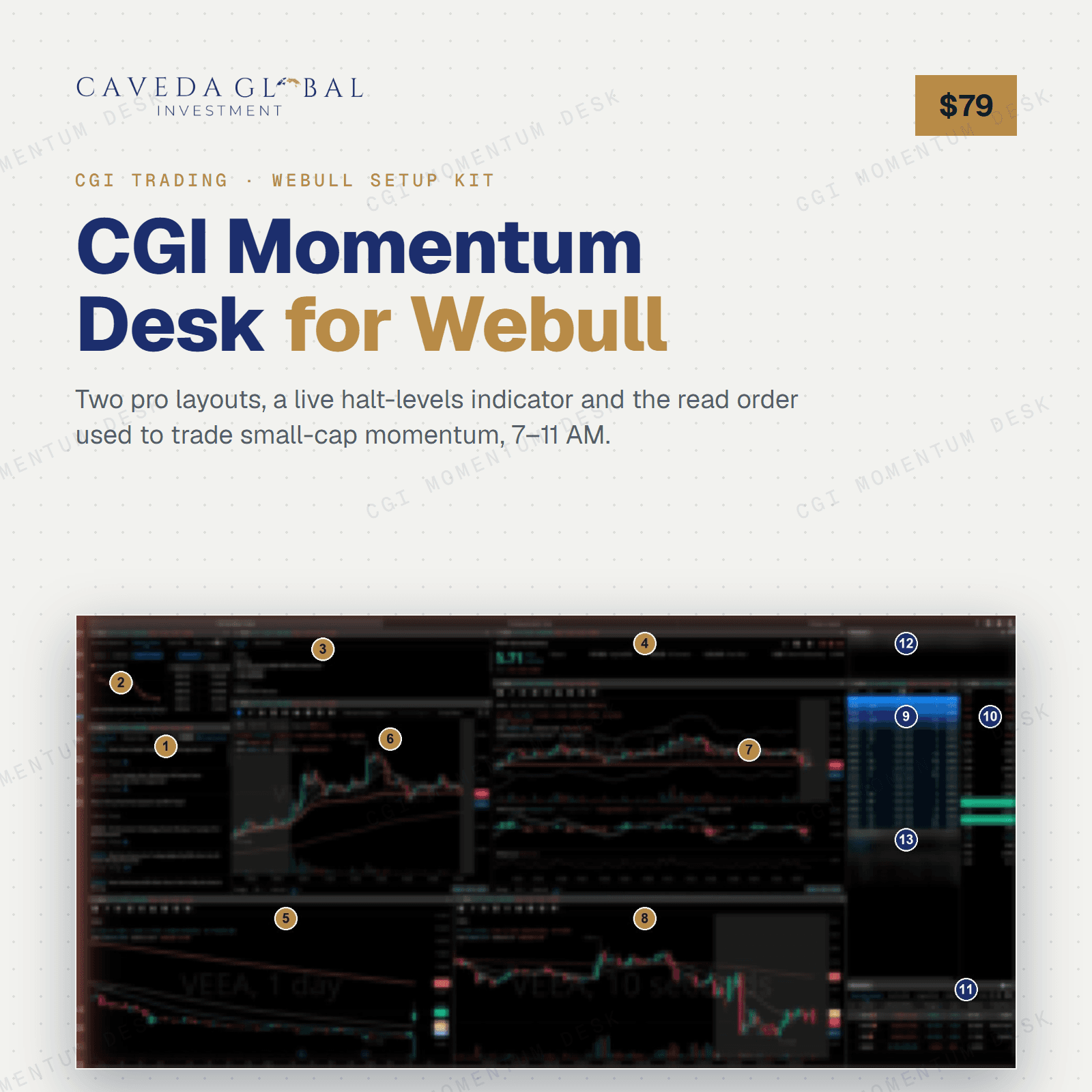
CGI Momentum Desk for Webull — Setup Kit (EN/ES)
The complete Webull Desktop setup for small-cap momentum traders running the 7–11 AM session — two one-click layouts (the 13-panel main desk and the scanner desk), a live LULD halt-levels indicator that shows exactly where a stock gets halted, the read order that takes every name from catalyst to entry, exact chart settings for the daily, 5-minute, 1-minute and 10-second charts, and the hot / cold rule for reading the market before the open. Includes a 10-page setup guide, the halt-levels script, and both layout links kept current in your account library. Fully bilingual — English and Spanish editions both included.
View the tool→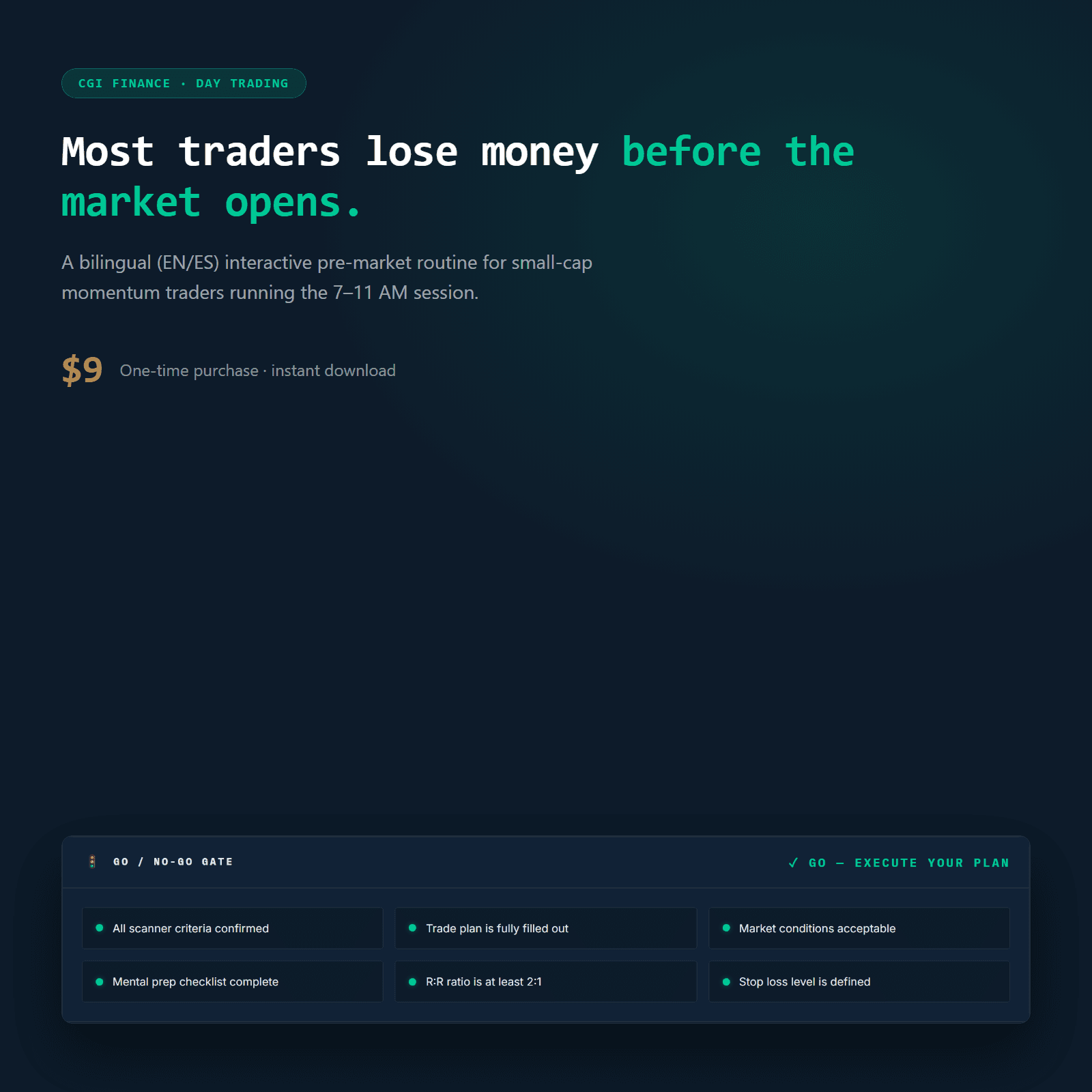
Day Trading Pre-Market Checklist (EN/ES)
The exact pre-market routine for small-cap momentum traders running the 7–11 AM session — scanner criteria, an 8-point stock qualification checklist, a market conditions check, a trade plan form, mental and risk prep, and a Go/No-Go gate that only turns green when every condition is actually met. Print it for a physical morning sheet, or run it live in your browser with a real-time clock. Fully bilingual — one click switches the entire checklist to Spanish.
View the tool→Webull
10 free fractional sharesBest platform for active trading
Advanced desktop charting, Level 2 market depth, and extended-hours trading — the toolset hands-on day traders actually want (premium unlocks the full suite). Webull also pays APY on your uninvested cash, so buying power sitting between trades keeps earning.
Open accountEverything here is for educational purposes only and is not financial, investment, or tax advice. Investing involves risk, including the possible loss of principal. Do your own research or consult a licensed professional before making decisions.